
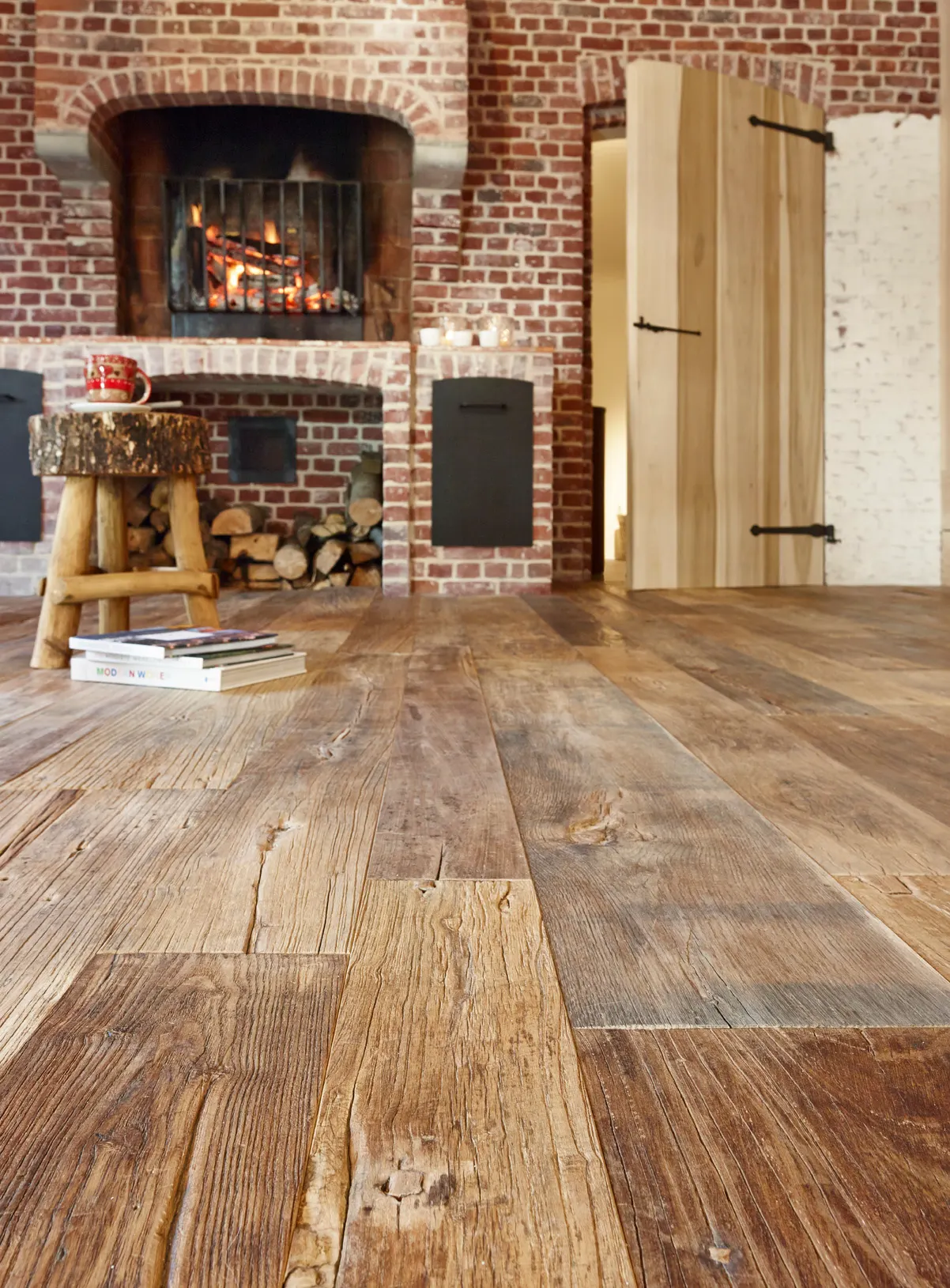
Flooring
Wood flooring, laminate and vinyl.
Flooring at Huys Houthandel is more than wood flooring: solid and engineered wood flooring, laminate, vinyl, cork and linoleum, with the underlays that go beneath them. Once laid, they can look alike, but they are made very differently. That decides how a floor feels, how it copes with moisture and whether you can sand it later. Here is the difference.
Solid wood flooring is one piece of wood from top to bottom. You can sand and refinish it several times, which is why it lasts the longest. Wood does move, though: it swells and shrinks with the humidity in the house, and a solid board moves the most. Solid flooring comes in oak and elm, from 14 to 21 mm thick. Mosaic parquet belongs here too – small wooden blocks laid in a chequerboard pattern – and so does industrial parquet: narrow strips set on their edge.
Engineered wood flooring has a top layer of real wood on a stable base, often of wood layers glued crosswise. That makes it move less than solid flooring, while you see the same wood on top. How often you can sand it depends on the thickness of the top layer. The description sometimes gives it: 15/4 is a 15 mm board with a 4 mm top layer.
Most of the wood flooring in the range is 10 to 15 mm thick and in oak, with beech, cherry, walnut, maple and bamboo besides. It comes unfinished or already finished: oiled, lacquered, smoked, which darkens oak, or brushed, which brings out the grain. There are narrow and wide boards, boards with a V-groove – a small bevelled edge that sets each board apart – and herringbone.
Laminate is not wood. It is a hard board of pressed wood fibres, HDF, with a printed image of wood or stone under a wear-resistant top layer. The boards click together. Sanding is not possible: what you see is a print. Laminate comes from 7 to 12 mm thick, mostly with a wood decor, sometimes with the look of stone.
Veneer is something else again: a sheet of real wood less than a millimetre thick, glued onto a board. It looks like solid wood, but the layer is too thin to sand. You will find veneer by the sheet, and veneered boards, under Sheet materials.
Vinyl is a plastic floor. It is thinner than laminate, feels softer and quieter underfoot and copes better with water than wood. Vinyl comes from 2 to 8 mm thick: the thinnest is glued to the subfloor, the thicker planks and tiles click together. There is also vinyl with a hard, rigid core, and there are vinyl stair treads.
Cork and linoleum are natural materials. Cork is warm and springy underfoot. Linoleum is made from linseed oil and wood flour, among other things. Both come as planks of about 10 mm.
A floor that is not glued but laid loose on the subfloor is called a floating floor. An underlay goes beneath it: foam, flooring felt or an underlay that dampens the sound of footsteps. On a stone subfloor you usually add a vapour barrier, a sheet that stops moisture rising from below.
Flooring is worked out in square metres (m²): the area you cover. Most floors come in packs, and each pack states how many m² it holds. The material calculator turns square metres into boards, with a little extra for offcuts.
For a quote, give us the area of each room, the floor you have chosen and what it will be laid on: concrete, a screed, tiles or a wooden floor. A plan or a photo helps. Torn between solid, engineered, laminate or vinyl? Call us and we’ll think it through with you.
Good to know
- Solid or engineered
- Solid can be sanded more often, engineered moves less.
- Laminate and vinyl
- Not wood: a print on fibreboard, or plastic.
- Cork and linoleum
- Natural floors, warm underfoot.
- With underlay
- Foam, flooring felt and vapour barrier.
Tell us what you need.
A question about sizes, quantities or prices? Send us a message or give us a call. We'll think it through with you.